Most companies that decide to build an in-house marketing team frame it as a breakup. The agency goes, a team arrives, and the savings pay for the salaries. That framing is usually wrong, and it is one of the main reasons in-house builds disappoint.
The data tells a less dramatic and more useful story. In the Association of National Advertisers’ 2023 study, 82% of ANA members had an in-house agency, up from 78% in 2018, 58% in 2013 and 42% in 2008. Yet 92% of respondents still worked with external agencies (ANA, 2023). The companies that went furthest in-house did not fire their partners. They changed what they asked them to do.
Jay Pattisall, VP and principal analyst at Forrester, put the shift plainly to Digiday:
“In-house is not a fad, it’s not even a trend. Insourcing marketing development and production is a marketing resource model and an efficiency strategy to meet the need for content to drive customer acquisition and retention.”
Jay Pattisall, VP and Principal Analyst, Forrester, speaking to Digiday (2023)
A resource model is a design decision, not a mood. This guide treats it that way: what to own, what to rent, who to hire first, what the first 90 days should produce, and how to use AI tools and bots without flooding the brand with noise. It is written for mid-size and growing companies, where one wrong senior hire can cost a year.
Why companies bring marketing in-house
A quick note on terms. This article follows the ANA’s usage of “in-house agency”: a company’s own team doing marketing work that could otherwise go to outside agencies. The ANA’s 2023 definition did not include internal public relations resources (ANA, 2023). It comes back later.
When ANA members ranked the primary benefits of their in-house agencies, the top four were cost efficiencies, better knowledge of the brand, institutional knowledge, and dedicated staff (ANA, 2023). Three of those four are about knowledge and attention, not money.
Control, brand knowledge, and institutional memory
An agency learns your business on a retainer clock. An internal team learns it every day, in meetings nobody would think to brief an agency on. Which product line has thin margins. Which executive will reject a headline that sounds too confident. That knowledge compounds, and it is the hardest thing to buy from outside. It belongs first in any business case, not last.
Cost structure (and what the savings claims leave out)
The savings can be real. Boston Consulting Group estimated that removing agency overhead and margin can save as much as 50% of agency and content-development costs, and cited Procter & Gamble cutting its agency and marketing relationships by 60% since 2015 and its external fees by $750 million (BCG, 2018). Those are 2018 figures from a very large advertiser, so treat them as a ceiling, not a forecast.
BCG is also clear about what the headline leaves out: real estate, technology and support functions move onto your books. Agency fees are variable. Salaries are fixed. With a seasonal workload, you can end up paying full-time rates for half-time work.
The companies that have been at this longest seem to know it. Among ANA respondents, the share rating cost savings as an important in-house KPI fell from 69% in 2018 to 62% in 2023, while the share rating business performance rose from 45% to 59% (Marketing Dive, 2023). My reading: if cost is your only argument, the first year of salaries, tools and training will make the project look like a mistake. Make the case on results and speed, and treat savings as a bonus.
Speed, content volume, and first-party data
In the ANA study, 88% of respondents reported an increased in-house workload, and 67% said it had increased “a lot” (Marketing Dive, 2023).
Speed is where in-house work tends to pay off first. In one BCG case, a consumer goods company that brought digital media work in-house raised its rate of on-time digital campaign launches from 20% to 83% (BCG, 2018). One company is not an industry average, but the mechanism is familiar: fewer handoffs, faster approvals.
Then there is data. BCG lists ownership of customer data and clarity about the customer journey as a core reason to insource. Media follows the same logic: 54% of ANA in-house agencies now handle some media planning or buying (Marketing Dive, 2023). If your performance data lives in an agency’s accounts, you are renting your own memory.
In-house vs agency marketing: a decision framework
The most useful sentence on this topic comes from Bill Duggan, group EVP at the ANA and author of its in-house report. As Digiday reported it, with its own clarifications in brackets:
“It’s not in-housing or [external agencies] but in-housing and [external agencies].”
Bill Duggan, Group EVP, ANA, as reported by Digiday (2023)
The real question is not whether to go in-house. It is which work. BCG suggests a simple litmus test: score your company from 1 to 5 on how much you need to own customer data and journey insight, how fast you must respond in digital and social channels, whether you can recruit and keep the talent, whether you have budget for technology and training, and whether the workload is steady year-round (BCG, 2018). High scores on control and speed, plus the ability to fund talent, point toward insourcing selected activities.
Work that belongs inside
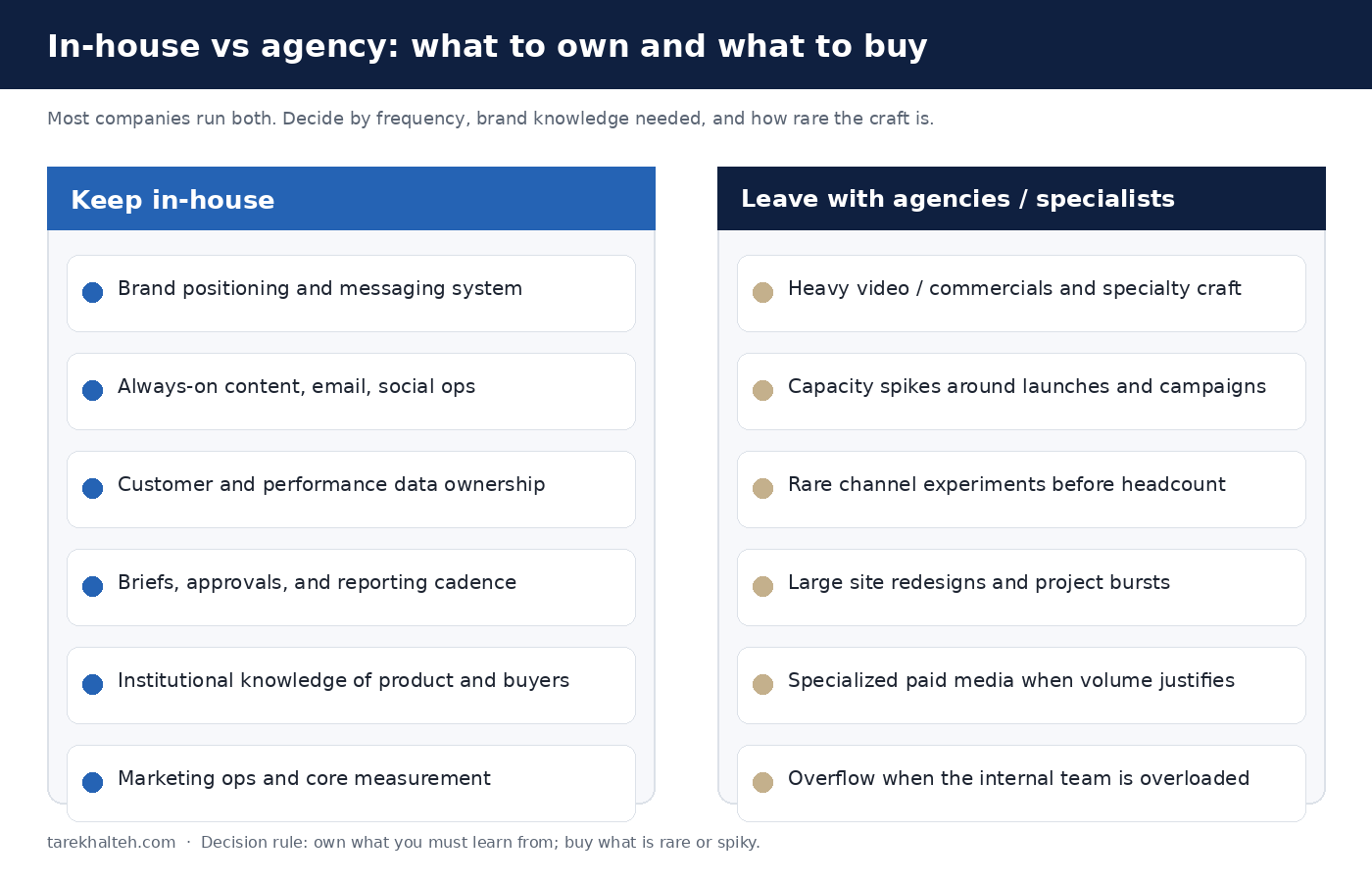
- Strategy and positioning. McKinsey’s view is that core strategy is best handled by the brand itself (McKinsey, 2021).
- High-frequency, always-on work: content, social operations, email, brand stewardship and marketing operations.
- Anything that needs deep context about products, customers, culture and internal politics.
- First-party data and measurement. You should be able to answer “what worked last quarter?” without filing a request.
Work agencies still win
Ann Billock, partner at Ark Advisors, pointed to the gap most in-house teams share:
“It’s not necessarily [a] move away from AOR relationship. In-house agencies most often don’t have the experience or expertise producing commercials and other video assets.”
Ann Billock, Partner, Ark Advisors, speaking to Digiday (2023)
More broadly, keep with agencies or specialists:
- Spike capacity, when the internal team is overloaded. Bandwidth is one of the main reasons work still goes outside (ANA, 2023).
- Capabilities you do not have, such as heavy video production or specialized paid media.
- Experiments in new channels before you commit headcount to them (McKinsey, 2021).
- Project work with a clear end: a site redesign, a rebrand, an episodic campaign (Mondo).
The hybrid model most companies actually run
Among ANA respondents who use both in-house and external resources, an average of 61% of the work is now done in-house, up from 58% in 2018. And 65% had moved some work from agencies to in-house over the previous three years (ANA, 2023).
“The most successful advertisers blend the in-house and external teams so that each plays a valuable and collaborative role in delivery.”
Jay Pattisall, Forrester, speaking to Digiday (2023)
Greg Paull, principal at the agency search firm R3, adds: “There are many good partnerships between in-house teams and the agencies that support them” (Digiday, 2023).
A rule that holds up: own what you need for control and learning, rent what needs to flex for cost and craft, and buy in whatever is too rare to staff full-time.
Marketing team structure: core capabilities
Start with capabilities, not titles. Mondo’s guide to in-house teams and CMO + Team’s hiring advice make the same argument: the structure should follow the work your business needs, not an org chart copied from a larger company (Mondo; CMO + Team). In a small team one person covers several, which is fine if someone clearly owns each.
Strategy and leadership
Someone has to connect marketing to business outcomes, set priorities and say no. Without this role, the team becomes an internal print shop for whichever department asks loudest.
Brand and communications
Positioning, messaging, tone of voice and the stories leadership tells in public. This is where marketing and communications overlap most, and where inconsistency is most visible to customers, partners and the press.
Content, demand gen, creative, and marketing ops
- Content: writing, editorial planning and multimedia briefs.
- Demand generation and digital channels: search, paid, email, social, and the funnel between them.
- Creative and production: design, layout and video.
- Marketing operations and analytics: reporting, data hygiene, workflow, ownership of the marketing technology stack, and basic AI literacy (which tools are approved, how to brief them, and who reviews the output).
McKinsey’s research on marketing organizations found that top-performing marketers were far more likely to work in networked organizations, 51% versus 18%, and that 71% of high-growth companies in its survey had adopted agile processes (McKinsey, 2017). The lesson is not to adopt a framework by name. It is that capabilities have to work across boxes.
Org chart stages for a growing firm
HubSpot offers a rough sizing sketch: roughly one marketer for companies under 25 employees, about three at 25 to 49, about eight at 50 to 249, and somewhere between 30 and more than 100 at 250 and up (HubSpot, 2025). Treat it as a planning sketch, not a rule. A regulated B2B firm and a consumer brand of the same size need different teams.
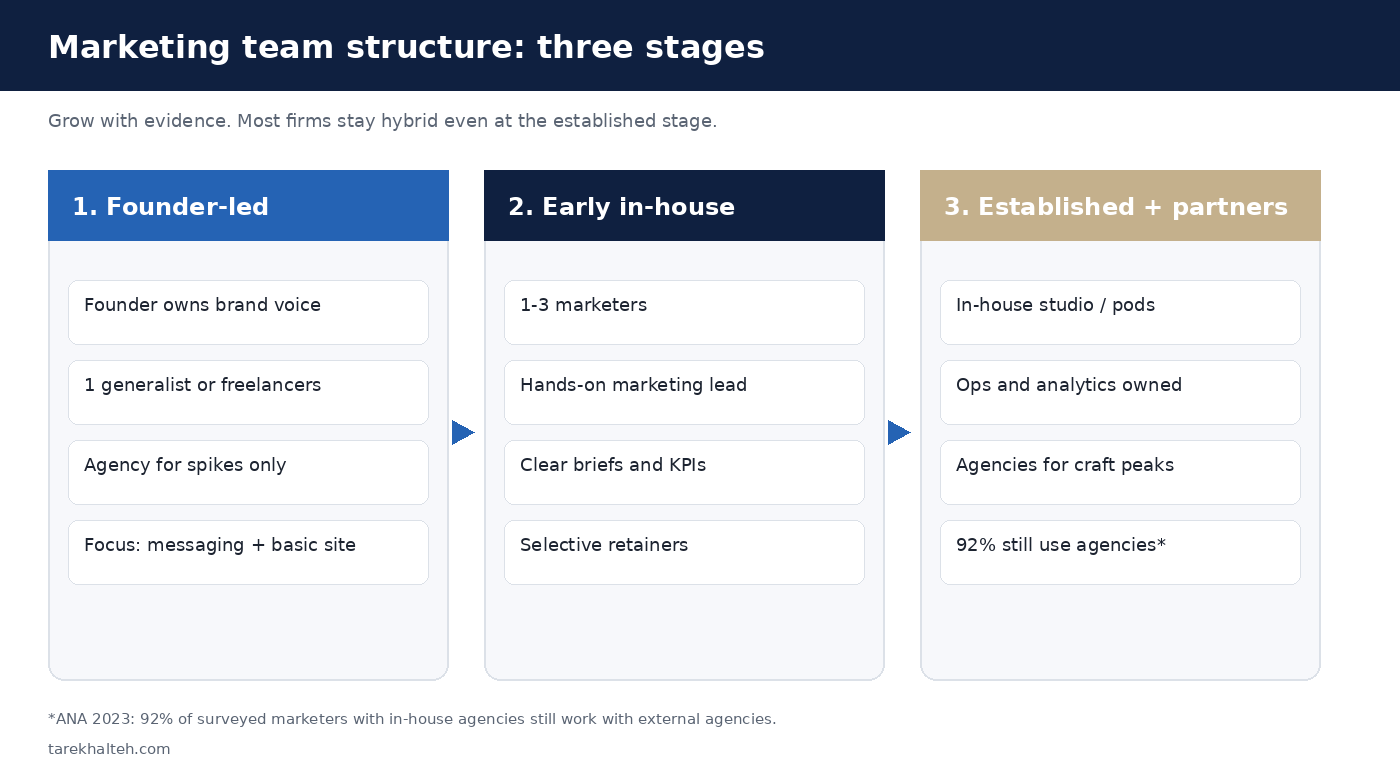
Founder-led
The founder is the brand. Marketing is messaging, a basic website and content, supported by a freelancer or one generalist. The risk at this stage is not a lack of output. It is that the company’s positioning lives only in the founder’s head.
Early in-house team
One to three marketers, mostly generalists, with agencies or freelancers for spikes. As the team grows, it usually splits into small discipline pods, such as content, demand and brand, under one marketing lead, with clear briefs and KPI ownership and a few selective agency retainers.
Established in-house agency plus partners
An internal studio or in-house agency handles strategy and most production. External partners handle craft peaks and specialties. This is the ANA model, and the 92% figure suggests most companies stay blended. These are stages, not a race.
Marketing roles to hire first
Start from the constraint, not a template org chart
Before you write a job title, name the problem. Is it pipeline? Positioning? A reporting mess nobody trusts? CMO + Team’s advice is to define the constraint first and let it choose the role (CMO + Team). A company with a positioning problem that hires a paid-media specialist will get more efficient traffic to a message that does not work.
Generalist first, then specialists
A sequence that suits most mid-size B2B and services firms:
- A senior, hands-on marketing lead who can set priorities, write, ship and report. Not a pure people manager with no craft, and not a CMO title with no budget or mandate.
- Content and brand, or demand generation, whichever is the bottleneck after 60 to 90 days of evidence.
- Marketing operations and analytics, once channels produce enough data to manage.
- Full-time creative when production volume is steady. Until then, contractors and agencies are cheaper and often better.
- Specialists in SEO, paid media or product marketing, only when the generalists are overloaded with clear, recurring work.
The trade-off is real. A generalist is slower at any one discipline. But a specialist hired too early spends half the week outside their skill set, and usually leaves.
What to look for in the first hire
Two qualities matter more than a perfect résumé. First, curiosity. Dave Schneider, CMO of Red Wing Shoe Co., described it to Jim Lecinski for Think with Google:
“First, we look for marketers who are curious. One of the most important qualities of a marketer is to seek to understand. Whether it is business performance, consumer behavior, or an emerging technology, the very best marketers have humility and seek to understand and are unafraid to ask, ‘Why?’”
Dave Schneider, CMO, Red Wing Shoe Co., via Think with Google (2024)
Curiosity about tools belongs in that same bucket. A first hire who experiments carefully with AI assistants, documents what works, and knows when to stop will beat a specialist who treats every new tool as either a threat or a miracle.
Second, writing. Ann Handley, author of Everybody Writes, argues that every marketer should be a “content person,” and puts it simply: “Becoming a good writer will help make you a great marketer” (Handley, 2014). Ask candidates for a brief they wrote, not only a campaign they ran. That skill still decides whether AI output is usable, because the tool goes through the writer, not around them.
How to build a marketing team in 90 days
The plan below is a synthesis of BCG’s audit advice, HubSpot’s and Mondo’s hiring guidance, the Forbes Agency Council’s emphasis on a written mission, and McKinsey’s work on agency ecosystems. It is not any single firm’s method. The point is to hire against evidence, not assumptions.
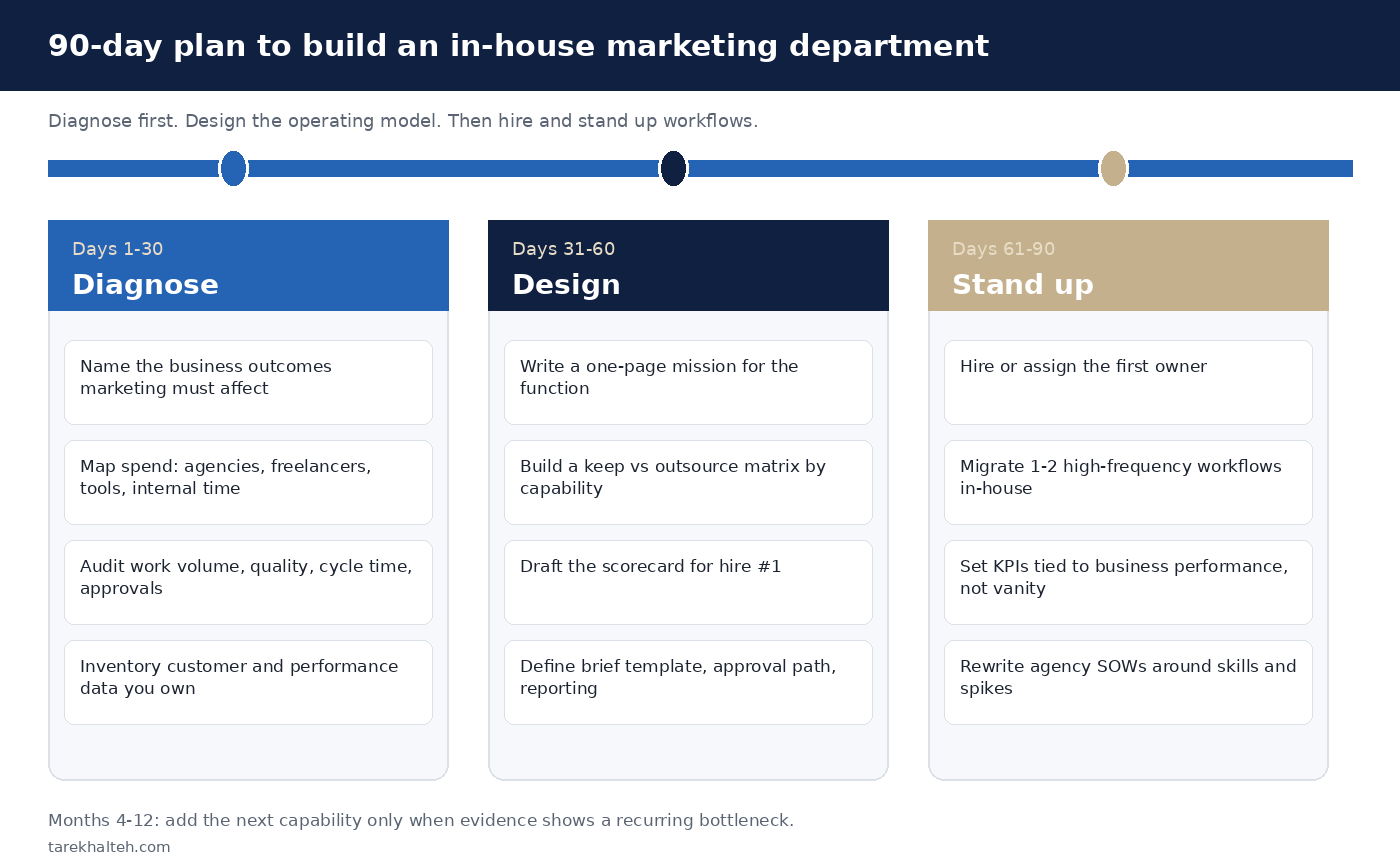
Days 1-30: diagnose spend, work, and data
- Name the business outcomes marketing must affect: pipeline, retention, reputation, launches.
- Map current spend across agencies, freelancers, tools and internal time.
- Audit the work: volume, quality, cycle time, and who approves what.
- Inventory the data: which customer and performance data the company actually owns and can access.
Days 31-60: mission, keep/outsource matrix, scorecards
- Write a one-page mission for the in-house function before hiring anyone (Forbes Agency Council, 2024).
- Build a keep/outsource matrix by capability, using the BCG litmus test above.
- Draft a scorecard for hire number one: outcomes in the first six months, not a list of tools.
- Define the brief template, the approval path and the weekly reporting rhythm.
- Write a one-page AI usage policy: approved tools, human review rules, what never goes into a prompt (customer PII, unreleased plans), and who owns standards.
- Choose a minimal tool stack.
Days 61-90: stand up workflows and reporting
- Hire or assign the first owner.
- Move one or two high-frequency workflows in-house, such as the content calendar and email, or social operations.
- Set KPIs tied to business outcomes, not only cost.
- Rewrite agency scopes around skills and spikes rather than a frozen deliverables list, as McKinsey recommends for agile marketing teams (McKinsey, 2021).
Months 4-12: expand with evidence
Add the second and third capabilities based on what the first 90 days showed. Plan in biweekly cycles. Review the agency mix every quarter, and each time ask what to bring in next and what should stay outside.
Briefs, approvals, and marketing department KPIs
Process is where in-house teams earn their speed advantage or lose it. Four habits cover most of it:
- A one-page brief for every piece of work: audience, the job it must do, proof points, call to action, must-say and must-not-say, channel, and due date.
- An approval service level: who signs off on brand, legal and subject matter, and how long each has.
- A weekly status note: work in flight, blockers, decisions needed.
- A monthly business review: contribution to pipeline or revenue, content that earned real attention, and cost against plan.
For marketing department KPIs, follow where experienced in-house teams have moved: business performance, quality and speed alongside cost, not cost alone (Marketing Dive, 2023). Share KPIs with agency partners too. McKinsey’s survey of senior marketers found that only 3% described their agile transition with partners as “smooth,” and more than 80% reported obstacles (McKinsey, 2021). Shared measures remove one of the easier ones.
Martech without overbuying
A software license is not a strategy. Tools bought before the workflow exists become expensive reminders of the process nobody designed.
Scott Brinker, editor of chiefmartec.com, gave advice in 2013 that still holds:
“My recommendation would be to start with a seed crystal: hire someone who can be a leader around which a technical marketing team can be grown. This is the role of the chief marketing technologist – or whatever ‘marketing CTO’-like title you prefer.”
Scott Brinker, editor, chiefmartec.com (2013)
In a mid-size company, the seed crystal is rarely a chief anything. It is the operations owner who decides what gets bought and makes sure people use it. Then:
- Write the workflow down before you buy the tool for it.
- Prefer fewer systems the team will actually log into.
- Make sure the company, not a vendor or agency, owns access to customer and performance data.
If your team also handles communications work, there is a separate guide on this site to the tools communications teams actually use.
AI tactics for an in-house marketing team
Generative AI moved into marketing stacks unusually fast. In MarTech’s 2025 State of Your Stack survey, done with chiefmartec.com and MarketingOps.com, generative AI tools were already used by 68.6% of organizations and ranked sixth among martech categories (MarTech, 2025). HubSpot’s 2024 AI Trends report found 74% of marketers using at least one AI tool at work, up from 35% the year before (HubSpot, 2024).
Among in-house agencies, the pattern is adoption without full integration. The In-House Agency Leaders Club’s 2024 survey found 78% of responding in-house agencies using generative AI, with 70% using it for creative concepting and 93% having used it to create images. Only 28% had put AI-generated images into live campaigns (IHALC, 2024). MediaSense and the World Federation of Advertisers reported a similar gap in 2025: 71% of in-house teams were implementing gen AI in specific areas and 65% were experimenting, but only 12% had fully integrated AI into their workflows. Every respondent reported faster production; 71% cited improved efficiency (MediaSense / WFA, 2025).
Speed without a better brief just produces more mediocre work. One WFA member in the MediaSense study put the bottleneck plainly: “AI can generate an image in three minutes, but if your legal approval process takes a week, you lose a week.”
Where AI helps first (and where humans stay in charge)
Useful early jobs for AI:
- Turning rough notes into a first-pass brief
- First drafts of emails, social posts and blog outlines
- Research summaries and competitor scans
- Meeting notes and action lists
- Translation drafts that a bilingual reviewer still checks
- QA checklists against brand voice, claims and link hygiene
Keep humans as the final call on:
- Positioning and brand voice
- Claims that need legal or factual sign-off
- Stakeholder and executive messaging
- Anything published under a named leader’s byline
- Customer promises and crisis communications
Ann Handley framed the tool well in a 2023 conversation with TopRank Marketing:
“I think of generative AI more as an efficiency tool than I do as a straight up writing tool. We call them writing tools, because that’s an easy way to talk about them. But I see them much more as efficiency accelerators than anything else, in B2B marketing.”
Ann Handley, Chief Content Officer, MarketingProfs, speaking to TopRank Marketing (2023)
And separately, when Bolger asked what generative AI can do for marketers:
“You may write faster first drafts, but you can’t shortcut relationships. You can’t prompt your way to trust.”
Ann Handley, via Bolger (2023)
HubSpot found that among marketers who use AI for written content, 86% edit before they publish (HubSpot, 2024). That should be the default, not a nicety.
How to optimize AI tools
Treat AI like a junior freelancer with a fast keyboard. The quality of the brief still decides the quality of the draft.
- Tie prompts to your one-page brief, not to a vague “write a LinkedIn post.”
- Load brand voice docs, messaging frameworks and must-not-say lists as standing context.
- Require a human review loop before anything customer-facing ships.
- Measure time saved and revision quality, not how many AI drafts the team produced.
- Name one owner for AI standards. In a mid-size company that is usually the same operations “seed crystal” Brinker described, not a separate AI department.
McKinsey’s 2024 consumer marketing survey found 74% of respondents viewing gen AI as more of an opportunity than a risk, yet only 5% were building gen AI capabilities and 4% were scaling use cases. The most common reported use was creative efficiency (39%), then personalization at scale and media optimization (28% each) (McKinsey, 2024). Mid-size teams should start where that survey points: a few high-frequency workflows with an owner, not a transformation program with none.
Scott Brinker, speaking with Snowflake about low-quality mass output (what he called “AI slop”), was blunt:
“That is the exact thing you do not want to be doing. That is destroying your brand.”
Scott Brinker, editor, chiefmartec.com, via Snowflake (2025)
Volume without judgment is not a marketing strategy. It is a brand tax.
AI bots and agents: useful versus noise
Brinker has argued that internal agents (the tools marketers use to brainstorm, analyze and produce content) are delivering the most tangible results today, while buyer-side agents will matter more later (CMSWire, 2025). For a mid-size in-house team, that points to a short list.
Bots that tend to help:
- FAQ and internal knowledge assistants grounded in approved docs
- Lead routing and form triage with clear handoff rules
- Content-ops checklists (missing alt text, claim review, broken links)
Bots that tend to create noise:
- Customer-facing chat with no escalation path to a human
- Unlogged bots that invent product claims
- Outbound SDR-style bots that spam your own market
Governance before you switch anything on:
- What the bot is allowed to say (approved answers only)
- When it must escalate to a human
- Logging of prompts and outputs for audits
- Caps on API spend; do not run open-ended live visitor experiments without budgets and kill switches
Train marketers to brief AI the way they brief freelancers: audience, job to be done, proof points, tone, and what not to say. Writing skill still decides whether the output is usable. Handley’s point stands: the tool goes through you.
If your team also handles communications work, deepen the stack with the tools communications teams actually use, then apply the same review rules above.
Common mistakes when building an in-house marketing team
- No written mission. The team becomes a service desk for every department.
- A cost-only business case. It breaks the first time salaries land.
- Pulling everything in at once, then struggling with specialty work like video.
- Fixed headcount for spiky demand, a risk BCG flags directly.
- A culture that cannot keep creative or technical talent. You end up paying for the learning curve twice.
- Tool sprawl without operators.
- Treating agencies as the enemy instead of partners for capacity and craft.
- Measuring activity instead of outcomes. Posts published is not a result.
- Publishing unedited AI output. It trains your audience to expect generic work and spends brand trust you cannot buy back with another tool license.
Where marketing and communications should meet
Recall the ANA definition: its in-house agency study left out internal PR. Many companies organize the same way, with marketing and communications in separate reporting lines. Customers do not see the org chart. They see one company speaking in an ad, on LinkedIn, in a press release and in a CEO interview.
An in-house marketing build that ignores communications tends to create two brands inside one company. The fix is not merging departments. It is a shared voice system: one messaging framework, one set of proof points, one editorial calendar that both teams can see, and agreed rules for executive visibility and media requests.
Ann Handley makes the case for why this deserves attention:
“Words matter. Your words (what you say) and style (how you say it) are your most cherished (and undervalued) assets.”
Ann Handley, author of Everybody Writes (AnnHandley.com)
This is where outside help can be worth it, if it is scoped honestly. A consultant or fractional lead can design the operating model, the messaging framework and the first hiring scorecard. They cannot replace a department. If you want a second opinion on that design, that is the kind of marketing and communications consulting I do.
Start with ownership, then hire
The companies that get the most from an in-house marketing department tend to make the same three moves. They decide what they need to own before they decide whom to hire. They hire a hands-on lead who can write and report, then add specialists only when the work proves it. And they keep agencies, but rewrite the relationship around craft and capacity. The better ones add a fourth habit: they treat AI as a briefed junior helper with standards, not as a substitute for judgment.
One test before you post the first job ad: write the one-page mission for the team and show it to your CEO and your agency. If either is surprised by it, you are not ready to hire yet.
If you are working through that decision now, let’s chat.
Sources
- Association of National Advertisers (2023). In-House Agencies No Longer A Trend – They’re Here To Stay: ANA Report. Press release, May 2, 2023.
- Association of National Advertisers (2023). The Continued Rise of the In-House Agency: 2023 Edition. Report summary.
- Baar, A. (2023). ANA: In-house agency trend continues to gain steam. Marketing Dive, May 8, 2023.
- Monllos, K. (2023). Marketing Briefing: As in-housing becomes a mainstay, marketer mindsets on in-housing vs. agencies needs to change. Digiday, May 9, 2023.
- Visser, J., Sheerin, A., Field, D. (2018). Is It Time to Bring More of Your Marketing In-House? Boston Consulting Group, July 31, 2018.
- McKinsey & Company (2017). Building a marketing organization that drives growth today. August 11, 2017.
- McKinsey & Company (2021). When agile marketing breaks the agency model. September 29, 2021.
- Chinn, A. (2025). How to Choose a Marketing Team Structure That Doesn’t Just Look Good on Paper. HubSpot Blog, updated May 1, 2025.
- Magazzo, S. How to Build an In-House Marketing Team: Roles, Skills, and What to Outsource. Mondo.
- CMO + Team. What Marketing Roles Should You Hire First?
- Lecinski, J. (2024). The CMO’s blueprint for building a world-class marketing team. Think with Google, November 2024.
- Ruskin, A. B. (2024). Building The In-House Marketing Team Of The Future. Forbes Agency Council, November 20, 2024.
- Handley, A. (2014). High-Fiving a Million Angels: It’s Launch Day for Everybody Writes. AnnHandley.com.
- Handley, A. 9 Qualities of Good Writing. AnnHandley.com.
- Brinker, S. (2013). 50% of all new marketing hires will be technical. chiefmartec.com, January 13, 2013.
- HubSpot Communications (2024). Marketers double AI usage in 2024. HubSpot.
- von Hoffman, C. (2025). State of the Stack 2025: Homegrown martech surges as AI accelerates development. MarTech, March 25, 2025.
- In-House Agency Leaders Club (2024). IHALC AI Survey Report 2024. PDF.
- MediaSense and World Federation of Advertisers (2025). In-Housing AI. November 5, 2025.
- McKinsey & Company (2024). Connecting for growth: A makeover for your marketing operating model. October 28, 2024.
- Meis, T. / TopRank Marketing (2023). Feeling B2B with Ann Handley. September 18, 2023.
- Hopeman, G. / Bolger (2023). Feature: What Can Generative AI Do for You?. July 24, 2023.
- Nicastro, D. / CMSWire (2025). Scott Brinker: The Four AI Agents Every Marketing Team Needs to Know. October 15, 2025.
- Takruri, L. / Snowflake (2025). Decoding AI’s Marketing Impact with Scott Brinker. July 10, 2025.
Tarek Halteh is a communications and program professional with 14+ years of experience across technology, international development and the MENA region. He currently works with Integrated International and writes about marketing, communications and how organizations build the teams behind them.

