
What a 41% AI automation score really says about the future of work, and where the money goes next.
This week a headline started making the rounds, built to scare people: that the Center for AI Safety is warning AI is closing in on the ability to automate all remote work, because Claude Fable 5.2 now completes 41.3% of real freelance projects, up from 2.5% a year ago.
The numbers are real. The conclusion people are drawing from them is not.
Here’s my take, in one line: you can make coffee at home, so why do you still buy it? You can make a sandwich, so why do you still order one? AI output will work the same way. Being able to do something has never meant everyone does it themselves. Someone still has to sit between the machine and the person who needs the result. That someone is the job of the next decade.
What the Remote Labor Index actually measures
The Remote Labor Index was built by the Center for AI Safety and Scale AI. Their research paper takes 240 real freelance projects that humans were actually paid for (3D modelling, architecture drawings, graphic design, video, data analysis, web apps) and asks one question: would a reasonable client accept the AI’s deliverable as at least as good as the professional’s?
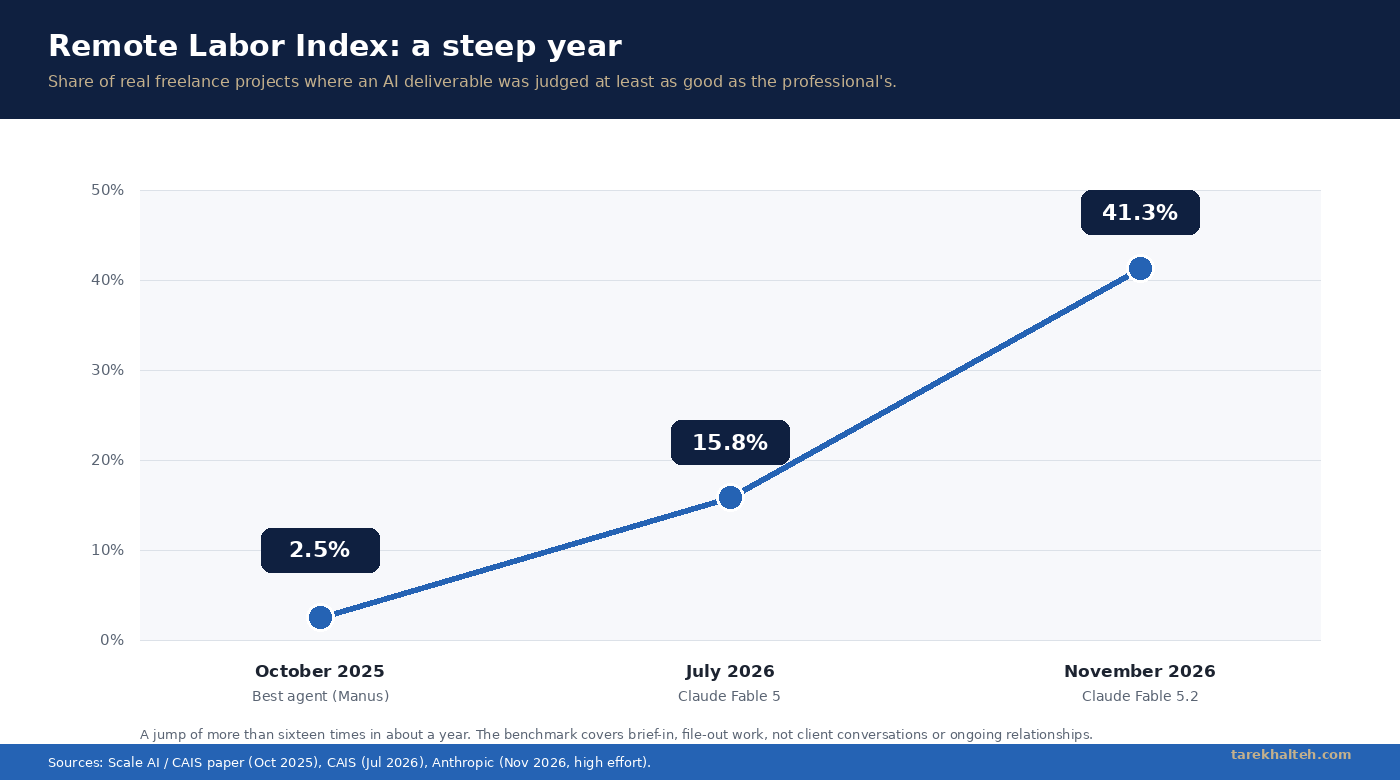
The trajectory is steep:
- October 2025: the best agent completes about 2.5% of projects. When the leaderboard launched, that agent was Manus.
- July 2026: Claude Fable 5 reaches 15.8%, the figure the Center for AI Safety published that month. That is the “roughly 16%” you may have seen.
- November 2026: Claude Fable 5.2 hits 41.3% at high effort. Anthropic reported that figure on November 9. Applied to the full set of 240 projects, it works out to about 99 of them.
Nobody should wave that away. A jump of more than sixteen times in about a year is the fastest change in this market I have seen. Anthropic’s own table, plus coverage from FourWeekMBA, MLQ.ai, DataCamp and LLM-Stats, all put Fable 5.2 at the same 41.3%.
But read the fine print. Scale’s leaderboard says the index deliberately excludes projects that need direct client interaction, physical work, or long-term evaluation. (It also scores the official leaderboard on 230 private projects, with 10 held back as a public set.) The benchmark measures the part of the job where a brief goes in and a file comes out. It does not measure the conversation before the brief, the judgement about what the client actually needs, or the relationship that brings the next project.
In other words, the benchmark leaves out exactly the work I’m talking about.
The coffee principle
A cup of coffee costs a few cents in beans. Most of us own a kettle. And yet coffee shops are everywhere, and the coffee industry is worth hundreds of billions of dollars. Grand View Research put the global coffee market at $249.3 billion in 2025, and estimated $263.5 billion in 2026.
Why? Because we were never really paying for the beans. We pay for:
- Time: someone else does it while we do something else
- Taste: someone who knows what good looks like
- Consistency: it comes out right every time
- Trust and experience: a place, a name, a person we rely on
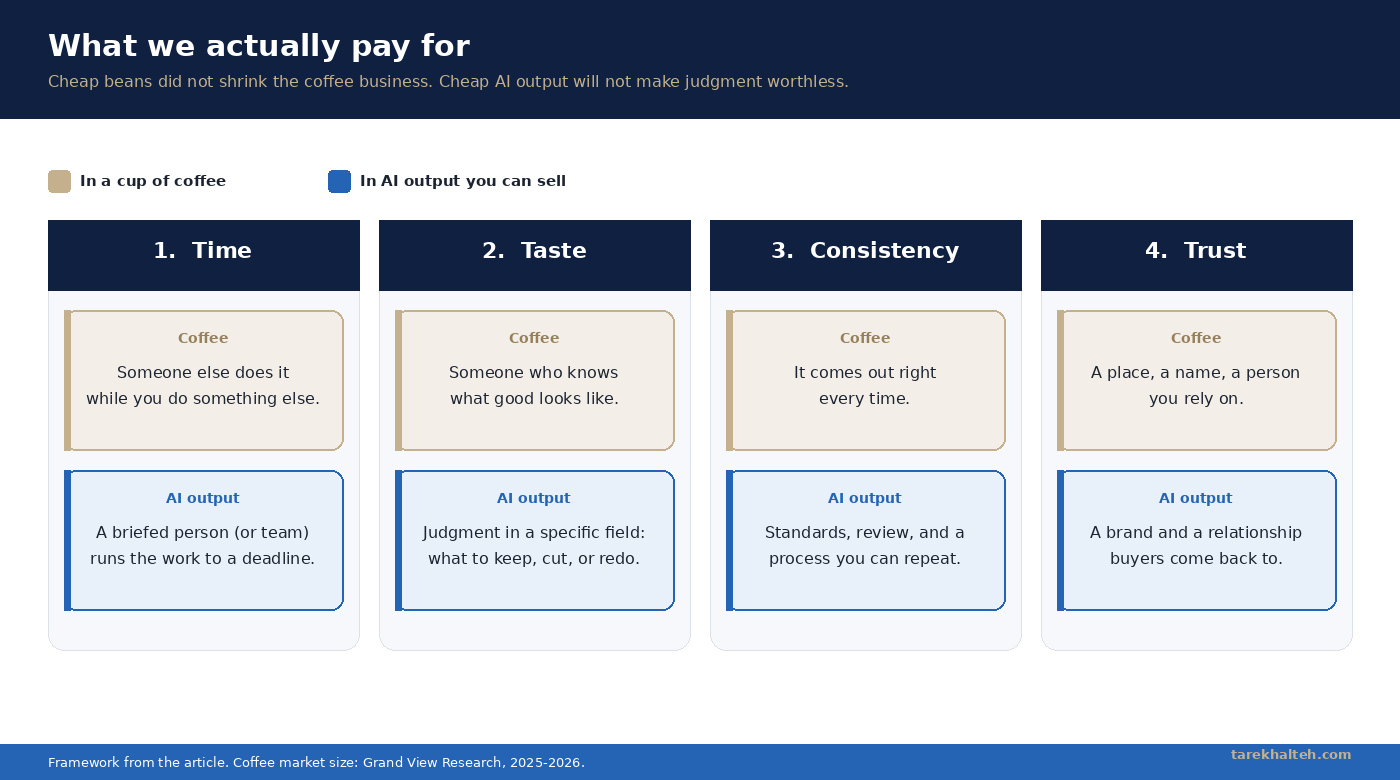
AI output is heading the same way. Generating a logo, a report, or a piece of code is becoming as cheap as boiling water. The finished product, chosen, checked, adjusted to the client, and delivered by someone accountable, is still worth paying for. Probably more than before, because there will be so much raw output around that the curated version stands out.
Someone has to talk to the AI
Every one of those 99 “completed” projects started with a human writing a brief and ended with a human judging the result. Take those humans out of the loop and the 41% is meaningless, because nobody would know what to ask for or whether the answer was any good.

As AI takes over production, three kinds of work grow:
- Direction: deciding what should be made, for whom, and why
- Quality and accountability: checking, fixing, and putting your name on the output
- Relationships: understanding a client’s business well enough to know what they need before they ask
Time freed from production does not disappear. It goes into more projects, more ventures, and more experiments that were too expensive to try before. Cheaper production has historically meant more demand, not less work.
If you are building a team around this idea, I have written separately about how to build an in-house marketing department that treats AI as a briefed helper, not a substitute for judgment.
Where the analogy breaks, and why that matters for your money
I’ll be honest about the weak point in my own argument. You buy coffee partly because of the barista, but a growing number of cafés already use automated machines. The “someone” who sits between you and the AI could, in some cases, also be AI.
So the protection is not “being human.” It is being the person the client trusts to decide. People who only produced output, the freelancer who turned a brief into a file and nothing more, are the ones most exposed. That is the 41%, and it will keep rising.
The ones who will do well are the people and companies who own:
- The client relationship (distribution beats production)
- Taste and judgement in a specific field
- A trusted brand that buyers return to
- Workflows that combine AI production with human oversight at scale
The investor’s takeaway
When a raw input becomes cheap, value does not vanish. It moves. Cheap beans built Starbucks. Cheap music distribution built Spotify. Cheap AI output will build a new layer of businesses that package, curate, and stand behind it.
If you’re investing (your money, your time, or your career), don’t bet on the product that is getting cheaper. Bet on whoever serves it.
The question for the next few years is not “will AI take my job?” It’s “am I the one making the coffee, or the one people trust to serve it?”
If you are thinking through what this means for a team you run, let’s chat.
FAQ
What is the Remote Labor Index?
It is a benchmark from the Center for AI Safety and Scale AI that tests AI agents on 240 paid freelance projects. The score is the share of projects where human evaluators judged the AI’s deliverable at least as good as the professional’s.
Does 41.3% mean AI is close to automating all remote work?
No. The 41.3% figure is Claude Fable 5.2’s score at high effort on this specific benchmark, not a share of all remote jobs. The index leaves out work that needs direct client interaction, physical labor, or long-term evaluation, which is a large part of how remote work actually gets done.
Which jobs look most exposed?
Roles that mainly turn a written brief into a file, with little client judgment attached, are the ones the index is built to measure. People who own the relationship, the taste, and the accountability sit outside that test.
If AI output gets this cheap, where does the money go?
It moves, the way it did when coffee beans and music distribution got cheap. The value shifts to whoever packages the output, stands behind it, and is trusted to serve it.
Sources
- Mazeika, M. / Center for AI Safety (2026). A Significant Increase in Digital Labor Automation. July 1, 2026.
- Mazeika, M., Gatti, A., Menghini, C., et al. / Center for AI Safety and Scale AI (2025). Remote Labor Index: Measuring AI Automation of Remote Work. arXiv:2510.26787, October 30, 2025.
- Scale AI (2025). The Remote Labor Index: Measuring the Automation of Work. October 29, 2025.
- Scale Labs. Remote Labor Index leaderboard.
- Center for AI Safety and Scale AI. Remote Labor Index.
- Anthropic (2026). Claude Fable 5.2 and Mythos 5.2. November 9, 2026.
- Cuofano, G. / FourWeekMBA (2026). Anthropic’s Fable 5.2 Does 41% of Freelance Jobs in RLI Test. November 11, 2026.
- MLQ.ai (2026). Anthropic’s Claude Fable 5.2 completes 41% of real freelance jobs on the Remote Labor Index, double the next model.
- Waples, J. / DataCamp (2026). Claude Fable 5.2 and Mythos 5.2: Our Take on the Upgrade. November 9, 2026.
- Chavez, J. / LLM-Stats (2026). Claude Fable 5.2: Anthropic’s Long-Horizon Model Gets Cheaper and Pulls Away. November 9, 2026.
- Grand View Research. Coffee Market Size, Share And Trends Report, 2026-2033.
Tarek Halteh is a communications and program professional with 14+ years of experience across technology, international development and the MENA region. He currently works with Integrated International and writes about marketing, communications and how organizations build the teams behind them.

